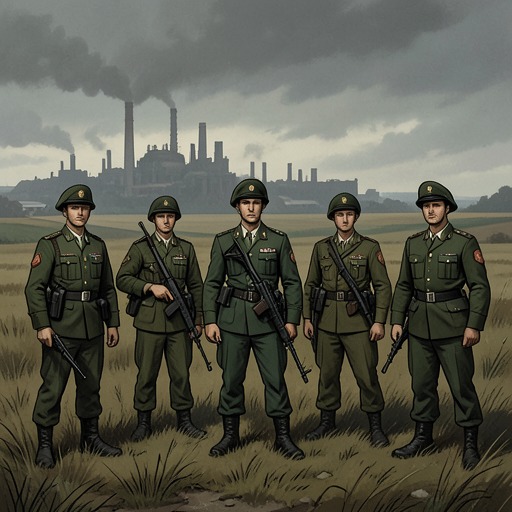
Ernst Kleiber
Los pacientes del doctor GarcíaErnst Kleiber is an SS captain whose immaculate uniform and controlled manner conceal the violence of his command. At Klooga, near the Narva front, he organizes the killing of two hundred Jewish prisoners and shoots Heinrich Beyer when the young soldier refuses to participate. His calm, procedural authority makes the massacre appear, for a moment, like an operation to be managed; the scene instead reveals the moral horror contained in that language of order.
Identity and Introduction
Kleiber enters the episode as an officer outside Adrián Gallardo Ortega’s unit, arriving by truck and asking for volunteers. Adrián understands little of the Flemish commander’s speech, but follows Kleiber’s German more readily because Jan Schmitt has been teaching him the language. The request is opaque: Adrián knows volunteers are wanted, but not what they are for. He stays in place until Jan nudges him and invites him to help the others. Adrián asks what they are going to do, but steps forward before he has thought it through.
The narrative’s first view of Kleiber is shaped by Adrián’s attention to his appearance. Kleiber is more than six feet tall, with a powerful frame and a disproportionately small, elongated head. His button-like eyes and horse-like jaw do not make him handsome; what impresses Adrián is his extreme neatness. His freshly brushed grey field uniform has no stain or loose hair, and its buttons shine uniformly. When Kleiber approaches the guards, the first ray of sun catches the braid on his insignia. The image gives his rank a false aura of distinction, sharply set against the people he has come to kill.
The Order at Klooga
The volunteers are taken to a clearing where they encounter two hundred prisoners, exhausted and emaciated, standing in the open. There are a hundred men and a hundred women. Adrián cannot initially understand why they have been brought there. Kleiber tells his men to wait beside the truck while he goes to confer with the chief of the guards. Adrián notices his youth and considers him too young for his position, but the polished uniform and measured conduct continue to set him apart from the suffering crowd.
When Kleiber returns, he walks slowly, as if taking time to look each soldier in the eyes. He lights a cigarette, inhales, and gestures behind him toward the prisoners. A thick murmur rises among the troops; Kleiber himself barely changes. He announces that the prisoners must be eliminated because the camp guards are insufficient to finish the work in time. He gives an operational plan: two firing squads of twenty-five men will take turns, the killing will be clean, easy, and quick, and the operation will be repeated in the afternoon before the soldiers return to their barracks. He calls this the plan of operations and asks whether anyone has a question.
Kleiber’s speech is chilling not only for what it orders but for what it leaves unnamed. He does not call the people prisoners, Jews, or human beings. Instead, he reduces their deaths to a task, organized by squad size, sequence, timetable, and convenience. The soldiers fall silent. Adrián looks down at Kleiber’s shoes and does not meet his gaze; he realizes only later that he has understood every word of the German. Nearby, Jan stares at the guards separating the men from the women, who are to die first, and repeats the dehumanizing claim that the prisoners are not human. Adrián quietly challenges that assertion, but his objection does not stop the order or the killings.
Beyer’s Refusal and Execution
When the firing squad raises its rifles, Heinrich Beyer remains standing with his weapon resting on the ground. He is praying, his lips moving rapidly as the women look toward him and pray as well. Kleiber orders the other soldiers to stand at ease and approaches Beyer from behind with his pistol drawn. He asks Beyer’s name and unit, then asks whether he heard the order and why he has not obeyed it. Beyer answers that his conscience will not let him shoot the women. He also acknowledges plainly that refusing a superior’s order constitutes insubordination and that he knows the punishment.
Kleiber places the pistol against Beyer’s forehead and shoots him. He then orders a German soldier to take Beyer’s place and tells two Estonian volunteers to remove the body, contemptuously calling it filth. The scene makes the violence of command immediate: Kleiber does not merely direct the execution of prisoners but enforces participation by killing a subordinate who refuses. Beyer’s right hand is still closed around the cord of his Sacred Heart scapular. He has had time to grasp it, but not to kiss it.
The Massacre and Adrián’s Complicity
After Beyer’s death, Jan resumes his whispered insistence that the prisoners are not human. The first volley sounds. A woman falls, and Adrián’s legs buckle; cold sweat soaks his shirt. The guards lay the bodies face down on logs, bring forward another group of twenty women, align them, and prepare the next volley. The killing proceeds in repeated, carefully arranged stages. In less than an hour, all one hundred women are dead, their bodies stacked in a long pyre between layers of logs. The men are killed afterward.
That night, Adrián returns by truck to the Narva front having participated in the murder of two hundred unarmed people: one hundred men in the morning and one hundred women in the afternoon. At midday, the volunteers had been given more generous rations than usual—stewed meat with potatoes, one chocolate bar for every two men, and a bottle of vodka for every four. They ate in silence until the vodka loosened the tongue of a corporal, who loudly joked about how well the Jews of Klooga had treated them. Some of the men laughed; not all did. The meal and the later joke extend the episode’s account of complicity beyond the firing line: the killings are followed by routine comforts and casual speech, while Adrián’s bodily reaction and memory mark what the language of procedure cannot erase.
Narrative Significance
Kleiber’s defining method is to turn murder into administration. His composure, the precise structure of the firing squads, and the timetable for completing the killings make atrocity sound manageable, while his euphemistic order suppresses the identity of its victims. The contrast between the immaculate officer and the starving prisoners exposes the moral falseness of his apparent discipline: order here does not restrain violence but organizes it.
His treatment of Beyer clarifies the coercion behind that order. Kleiber presents refusal as a punishable breach of military hierarchy, then kills the conscientious objector and fills the vacant place in the firing squad. The scapular clasped in Beyer’s hand offers a stark counter-image to Kleiber’s authority: a private sign of faith held by a soldier who accepts the consequences of disobedience rather than shoot the women. Adrián, who had volunteered without understanding what awaited him, leaves the clearing as a participant in the massacre. His later recognition that ignorance will not free him from guilt gives Kleiber’s command its enduring consequence: the officer’s system depends on obedience, but those who obey remain implicated in what it makes possible.